
sooksook-E-learning
Affiliate module 19 Sections170 LessonsDurée de vie
Why 1 hour max
WHY YOU SHOULD NOT WAIT MORE THAN AN HOUR
Nor start a new task before writing your intervention report, diagnosis or report
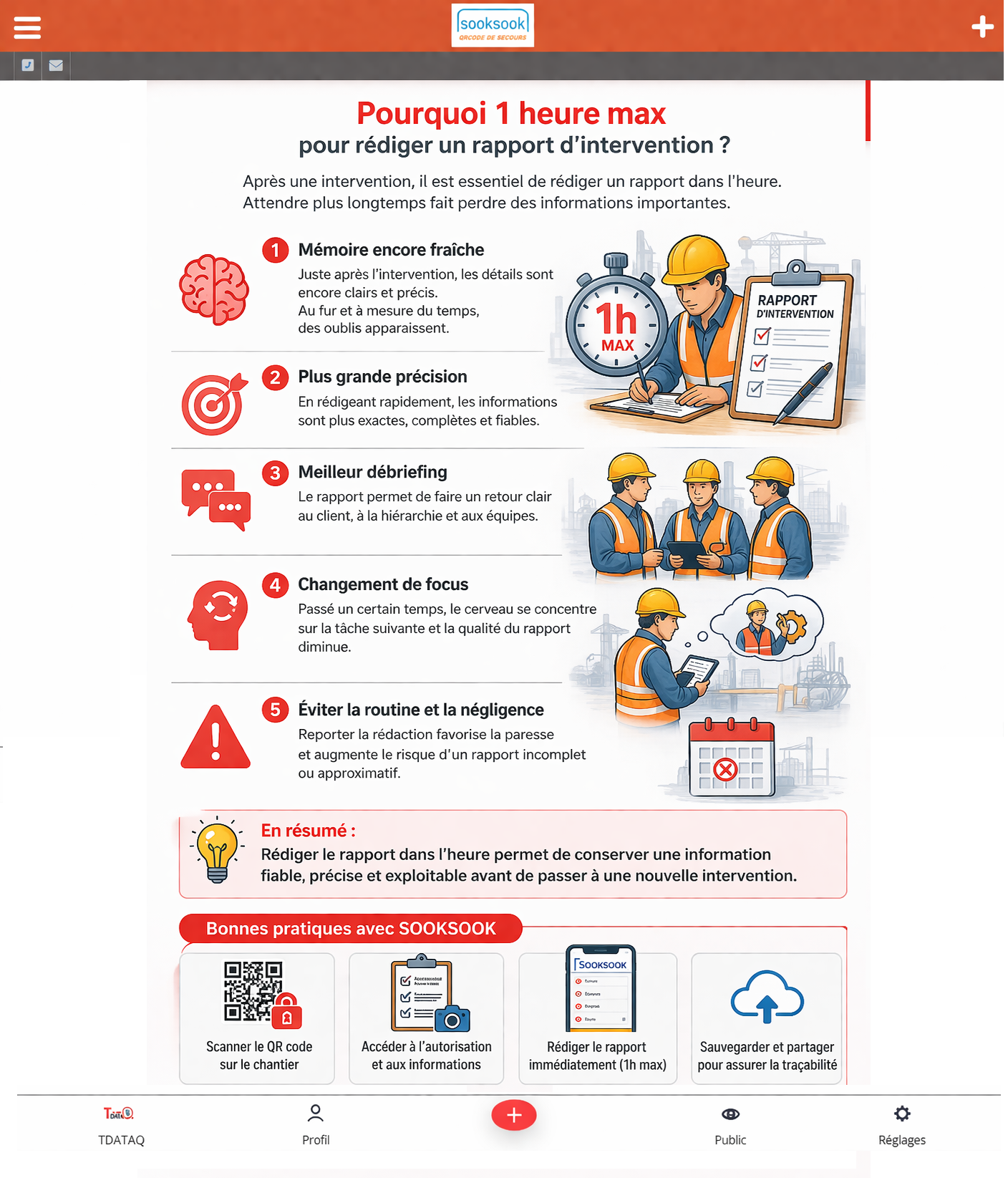
In the SOOKSOOK working method, one principle is essential:
an intervention report, a diagnosis or any other report must be written quickly after the action, ideally within an hour, and before starting a new task.
This principle may seem simple, but it has major importance.
It directly affects the quality of the information, the reliability of field feedback, traceability, security and the real value of the work carried out.
1. Because memory deteriorates very quickly
Just after an intervention, the elements are still fresh in the mind:
- the exact context
- the anomalies observed
- the actions carried out
- the difficulties encountered
- important exchanges
- visual observations
- the hypotheses formulated
- useful technical details
But the more time passes, the more the memory loses precision.
Beyond a certain period of time, and in particular beyond an hour, we often start to:
- forgetting details
- mix certain elements
- oversimplify
- reformulate less faithfully
- omit what seemed obvious at the time
The brain does not retain everything with the same clarity.
What is not formalized quickly begins to fade away.
2. Because we become less precise
A good report should not just say that an action was carried out.
It must also reflectwhat really happened.
However, when we wait too long, we lose finesse in the restitution.
We become more vague on:
- the exact steps
- the order of events
- the symptoms observed
- the tests carried out
- equipment reactions
- points of vigilance
- the real conditions of the intervention
The report then becomes poorer, less useful and less usable.
It may remain correct in broad terms, but it loses its technical and operational value.
3. Because the brain is already planning on the next task
In real work, the days often move quickly.
Once an intervention is completed, another task is already waiting:
- another repair
- another request
- another emergency
- another call
- another priority
The problem is that, as soon as we mentally switch to the next step, our attention leaves the previous intervention.
The brain then begins to focus on:
- what to do next
- what not to forget
- what is pressing
- what happens
- what remains to be processed
From this point on, the quality of the return on the previous action declines.
We write less with the mind still in the intervention, and more with the desire to move on to something else.
The relationship becomes faster, more mechanical, sometimes more superficial.
4. Because a new task pollutes the reading of the previous one
Starting a new intervention before having written the report for the previous one creates a risk of confusion.
The information can be mixed:
- the symptoms observed
- the places
- the schedules
- the equipment
- the interlocutors
- the tests carried out
- technical conclusions
Even when you think you have the situation under control, the simple sequence of actions can alter the clarity of the memory.
This is even more true when the days are busy, repetitive or technical.
Writing before moving on allows you tocorrectly close an action before opening another.
5. Because intellectual laziness ends up taking over
We also need to say things clearly:
The longer we wait, the more we tend to postpone.
At the beginning, we say to ourselves:
- “I will do it a little later”
- “I will remember”
- “it doesn’t matter, I still have the outline”
Then, over time, a form of fatigue or intellectual laziness may appear.
We no longer want to make the mental effort to dive back into precisely what happened.
We then try to go faster.
We simplify.
We summarize too much.
We write the minimum.
This is not necessarily bad will.
This is often a natural mechanism: the more a task is delayed, the more mentally heavy it becomes, and the less we want to handle it with precision.
It is precisely to avoid this that the SOOKSOOK method imposes simple logic:
we write while the intervention is still alive in the mind.
6. Because a report written on the spot has more value
A report written quickly after the intervention is generally:
- more faithful
- more precise
- more concrete
- more useful
- more credible
- more usable by others
It renders better:
- the reality on the ground
- real conditions
- the symptoms observed
- the actions carried out
- diagnostic logic
- things to watch out for
- the follow-up
In other words, it has real operational value.
Conversely, a report written too late risks being more administrative than technical, more approximate than accurate.
7. Because the report also serves others
A report is not just a document that you fill out for yourself.
It also serves other people:
- colleagues
- responsables
- encadrants
- order givers
- partenaires
- technicians who will then intervene
- people responsible for monitoring
If the report is incomplete or imprecise, others are working with a degraded view of reality.
They can then:
- misunderstand the problem
- waste time
- repeat checks already carried out
- poorly prepare for what comes next
- miss an important detail.
Writing quickly and correctly also means respecting collective work.
8. Because traceability depends on the quality of the writing moment
Traceability is not just about having a report.
It consists of having agood report, written at the right time, with the right level of quality.
If the report is filed too late, the trace may exist, but it is weakened.
Useful traceability must make it possible to understand:
- what was observed
- what was done
- why this was done
- under what conditions
- with what results
- what consequences are envisaged
This quality strongly depends on the proximity between the action and the writing.
9. Because it reinforces professional rigor
Getting into the habit of writing immediately or within the next hour, before any new task, develops healthy work discipline.
This allows you to:
- correctly close an intervention
- maintain a high level of standards
- avoid the accumulation of delays
- keep a clear logic during the day
- value your own work
- produce serious and usable information
It is a marker of professionalism.
A job well done does not stop at technical action.
It also includes the quality of intervention feedback.
10. The simple rule of the SOOKSOOK method
The SOOKSOOK method therefore retains a clear rule:
After an intervention, a diagnosis or a significant action, the report must be written before starting anything else, and ideally within an hour maximum.
For what
Because beyond:
- we forget elements
- we become less precise
- we mix information more easily
- the brain is already planning ahead
- the quality of the feedback drops
- intellectual laziness increases
- the value of the ratio decreases
Why 1 hour maximum
You should not wait more than an hour, nor start a new task, before writing an intervention report, a diagnosis or any other report.
Beyond this deadline:
- memory loses precision
- some details are forgotten
- the findings become less faithful
- the brain is already focused on the next task
- information can be mixed
- fatigue and intellectual laziness lead us to oversimplify
Writing quickly therefore allows you to produce a report:
- fairer
- more precise
- more useful
- more usable
- more professional
The report is part of the job.
It should not be treated after the fact as a formality, but as the last essential step of the intervention.