
sooksook-E-learning
Affiliate module 19 Sections170 LessonsDurée de vie
Détails
- 19 Sections
- 170 Lessons
- Durée de vie
- Introduction2 Items
- histoire4 Items
- Pourquoi?3 Items
- Nos valeurs8 Items
- Boutique SHOP.SOOKSOOK.FR8 Items
- Méthode de travail10 Items
- 6.1MUTUALISATION ET PARTAGE DES STANDARDS ET DES BONNES PRATIQUES
- 6.2Méthode de travail sooksook.fr qrcode secours
- 6.3Pourquoi 1h max ?
- 6.4Démarrage intervention
- 6.5cadenas qrcode
- 6.6Porte document verrouillable
- 6.7Moment sécurité et standard avant intervention
- 6.8Importance des rapports
- 6.9Importance des dates
- 6.10Valeur ajoutée au travail effectué
- ERP envoi sur serveur SFTP20 Items
- 7.1Automatisation de l’intégration ERP
- 7.2Pourquoi automatiser l’intégration ERP
- 7.3Rôle de SOOKSOOK dans l’architecture
- 7.4Sources des données à intégrer
- 7.5Objets métiers pouvant être envoyés vers l’ERP
- 7.6Principe général du flux automatisé
- 7.7Conditions de déclenchement de l’intégration
- 7.8Gestion des utilisateurs autorisés
- 7.9Création d’avis par messagerie
- 7.10Principe du mot clé commun
- 7.11Page de programmation XML
- 7.12Construction du XML par glisser-déposer
- 7.13Nommage des balises XML
- 7.14Paramétrage avancé du XML
- 7.15Données pouvant entrer dans le XML
- 7.16Génération automatique du XML
- 7.17Génération automatique du XML
- 7.18Gestion des pièces jointes
- 7.19Key user
- 7.20Parametrage serveur
- Fonctionnalités SOOKSOOK.FR32 Items
- 8.1Onglet : QRCode
- 8.2Onglet : Activité
- 8.3Onglet : Groupes
- 8.4Onglet : Evenement
- 8.5Onglet : Document
- 8.6Mes publications
- 8.7Métier – Competence
- 8.8Onglet : Exposition risque danger epi
- 8.9Onglet : Exposition machine
- 8.10Barre footer SOOKSOOK
- 8.11Abonnenment : suivre cet auteur
- 8.12Bouton me contacter
- 8.13Profil – Info
- 8.14Info supplémentaire
- 8.15Subscribe / Abonné
- 8.16Publipostage
- 8.17A faire – En cours
- 8.18Messagerie
- 8.19Gr/co économisé
- 8.20Badge Elearning
- 8.21Avatar et photo de couverture
- 8.22Widjet
- 8.23Description
- 8.24Statut machine appareil equipement
- 8.25Page d’avis : note : appréciation /commentaire
- 8.26Page Favoris
- 8.27Barre header SOOKSOOK
- 8.28Paramètres du compte : E-mail & Mot de passe Notifications Confidentialité du compte
- 8.29Creation d’avis et mots clé profil
- 8.30Affichage QRCODE
- 8.31Publication
- 8.32Notification
- Formulaire de publication14 Items
- 9.1CAS D’UTILISATION : LA CRÉATION DES PUBLICATIONS PAR CHOIX ET L’UTILISATION DES FORMULAIRES
- 9.2Formulaire de publication
- 9.3Formulaire de publication : Audit-Prévention-Standard -Sécurité
- 9.4Formulaire de publication : Rapport
- 9.5Formulaire de publication : Zone – Espace – Locaux
- 9.6Categorie
- 9.7Event date
- 9.8Secteur d’actvité
- 9.9Risques-Dangers
- 9.10EPI
- 9.11Outils
- 9.12Media
- 9.13Localisation- Geolocalisation
- 9.14Validation pour publication
- Utilisation10 Items
- 10.1Cas d’utilisation
- 10.2CAS D’UTILISATION : APPAREIL / ÉQUIPEMENT / MACHINE / ZONE IDENTIFIÉE
- 10.3CAS D’UTILISATION : AGENT / UTILISATEUR
- 10.4ERP
- 10.5formulaire agents
- 10.6Formulaire : appareil equipement machine
- 10.7Creation arborescence – Cartographie technique interactive
- 10.8Documentation – Archivage
- 10.9Activation et première utilisation
- 10.10CAS D’UTILISATION GROUPES / EQUIPES
- IOT5 Items
- Supervision8 Items
- Plateforme E-learning : tdataq.sooksook.fr18 Items
- 13.1E-learning connecté aux formulaires terrain
- 13.2Une bibliothèque complète
- 13.3Librairie Sécurité & Prévention
- 13.4Exemple concret : Moment Sécurité
- 13.5Librarie métier
- 13.6Relation entre T-DATAQ E-Learning et SOOKSOOK
- 13.7Lien direct avec les thématiques
- 13.8Barre footer
- 13.9Catalogue des E-learning – T-DATAQ
- 13.10Pourquoi limiter à 1 E-learning par jour ?
- 13.11Défis & Challenges
- 13.12Récompenses : transformer l’engagement en valeur réelle
- 13.13Compte & Profil utilisateur – T-DATAQ
- 13.14La boutique T-DATAQ
- 13.15Accès libre à la librairie T-DATAQ
- 13.16Catégories
- 13.17Historique et Cours suivi
- 13.18Réglages
- Retribution1 Item
- Avantage / Gain12 Items
- 15.1Synergie équipe
- 15.2Analyse 5S
- 15.3Gain de Temps
- 15.4Entreprise utilisatrice
- 15.5Entreprise exterieur
- 15.6HSE
- 15.7Hierarchie – Management
- 15.8Production
- 15.9Efficacité terrain : exemple plan en machinerie
- 15.10Prévention – Sécurité
- 15.11Gains
- 15.12Gains générés pour les utilisateurs, avec ou sans compte SOOKSOOK
- Points forts10 Items
- Cible1 Item
- Outils disponible2 Items
- Récapitulatif2 Items
Creation of reviews and profile keywords
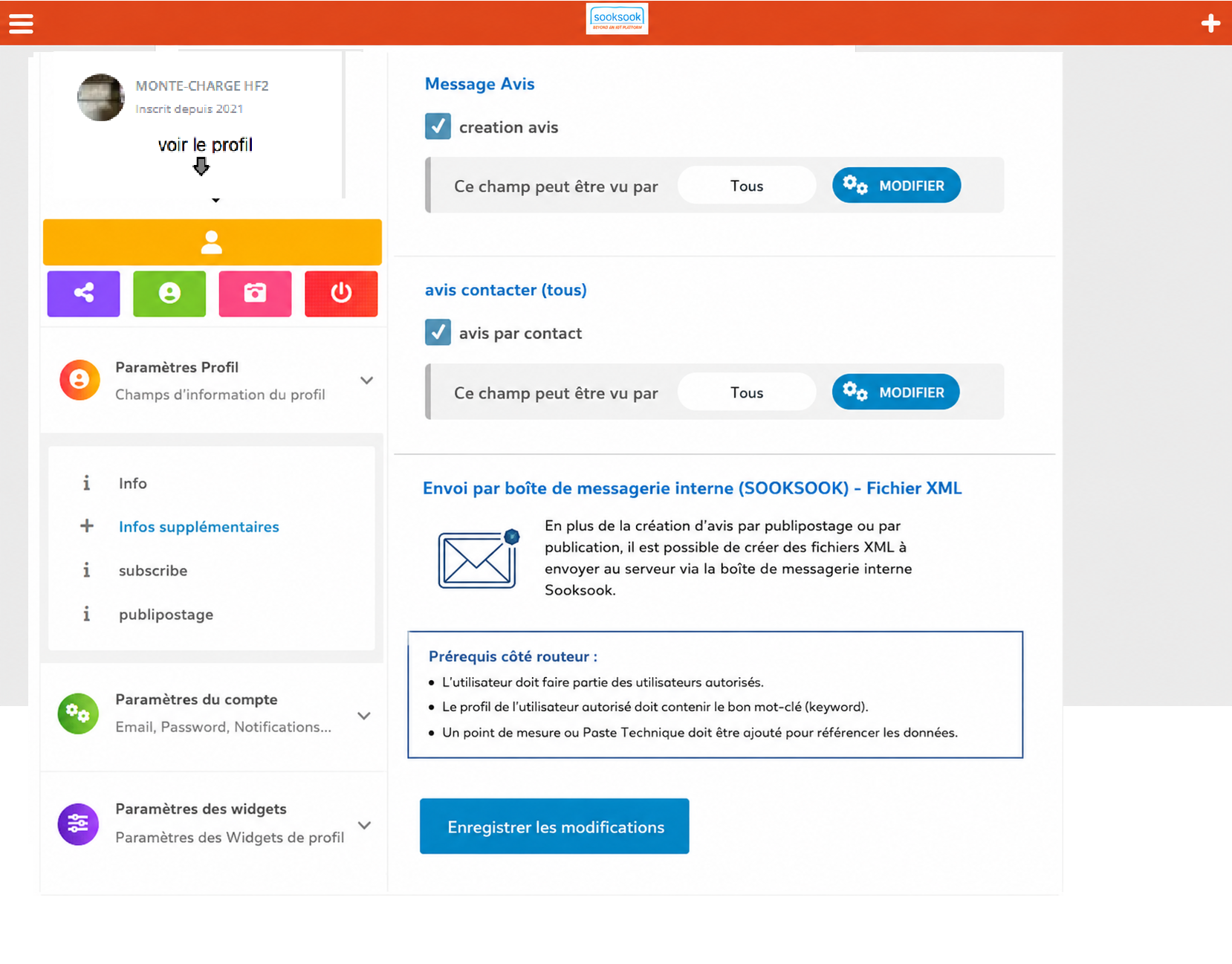
Sending XML files via SookSook internal messaging
In addition to the creation of reviews bypublipostageor byfield publication, SookSook also allows you to generatestructured XML filesthat can be sent to a server or an external system, such as an ERP, a maintenance tool or an automatic processing gateway.
This functionality allows information entered in SookSook to be transformed into a file that can be used by another computer system. The objective is to limit double entries, make exchanges more reliable and facilitate the automatic transmission of field data.
In this case, sending the XML file can be done directly via theSookSook internal mailbox. The authorized user can thus send a request, a notice or structured information to a router or a server responsible for retrieving and processing the message.
Principle of operation
The operation is based on simple logic:
The user prepares or triggers a request from SookSook. This request contains the information necessary to create an XML file: description of the intervention, equipment concerned, technical station, measurement point, message, attachments or other useful data.
Once the request is sent via internal messaging, SookSook can generate an XML file conforming to the expected structure. This file can then be transmitted to the server or router responsible for the integration.
The server can then retrieve this data and use it to automatically create a notice, a notification, a maintenance event, technical monitoring or an intervention request in an external system.
Necessary conditions on the router side
For the system to work correctly, certain conditions must be met on the router or receiving server side.
First of all, the user sending the message must be one of theauthorized users. This prevents any profile from triggering the creation or sending of XML files to the server.
Then, the profile of this authorized user must contain thegood keyword. This keyword serves as a cue for the system to identify that the message should be treated as a specific request. It allows the router to automatically recognize the type of action to perform.
Finally, ameasuring pointor atechnical positionmust be informed. This information is essential because it allows the request to be correctly linked to a specific piece of equipment, installation, area or machine. Without this attachment, the XML file may not be usable correctly by the recipient system.
Role of the keyword in the user profile
The keyword plays an important role in triggering automatic processing.
It identifies that the user is authorized to send this type of request and that the message must be interpreted as a command or technical instruction. The router can then check the presence of this keyword before accepting processing.
This adds extra security, as simply sending a message is not enough. The user must be authorized and their profile must contain the expected information.
Importance of the technical station or measuring point
The technical station or measurement point makes it possible to link the request to a real element on the ground.
For example, it could be:
an elevator,
a freight elevator,
an industrial door,
of a machine,
production equipment,
a technical area,
a sensor,
or a specific organ to be monitored.
This connection is essential so that the external system knows precisely to which equipment to attach the information received. It also allows clear traceability to be maintained in the technical history.
Advantage of sending by internal courier
Using SookSook internal messaging brings several advantages.
It allows exchanges to be centralized on the platform. Messages remain associated with users, profiles, devices and histories. This avoids dispersing information across several different tools.
It also allows you to keep track of the request sent. We can know who sent the message, when, for what equipment and with what information.
Finally, it facilitates automation. The internal message becomes a structured transmission medium between the field and the destination computer system.
Example of use
An authorized user notices a problem with equipment. It uses SookSook to send information via internal messaging.
The message contains the necessary elements: the equipment concerned, the technical station, the measurement point or the identifier of the installation, as well as a description of the problem or intervention.
The router receives the message, verifies that the user is one of the authorized users, checks the presence of the correct keyword in his profile, then retrieves the necessary data.
SookSook peut alors générer un fichier XML et l’envoyer au serveur pour traitement. Le système externe peut ensuite créer automatiquement un avis ou une demande d’intervention.
Purpose of this feature
This functionality makes it possible to make the link between field information entered in SookSook and the IT tools used by the company.
It improves:
traceability,
the speed of transmission,
the reliability of the data,
reducing double entries,
the centralization of exchanges,
and integration with existing systems.
It transforms SookSook internal messaging into a real communication gateway between field users, equipment and management systems.
Short text for user documentation
In addition to creating notices by direct mail or publication, SookSook allows you to generate XML files that can be sent to a server via internal messaging.
For this function to work, the user must be authorized on the router side. Its profile must contain the expected keyword so that the system automatically recognizes the type of processing to be carried out. A measuring point or technical station must also be entered to correctly link the request to the equipment concerned.
This functionality makes it possible to automate the transmission of field data to an external system, while maintaining complete traceability in SookSook.