
sooksook-E-learning
Affiliate module 19 Sections170 LessonsDurée de vie
Added value to the work carried out
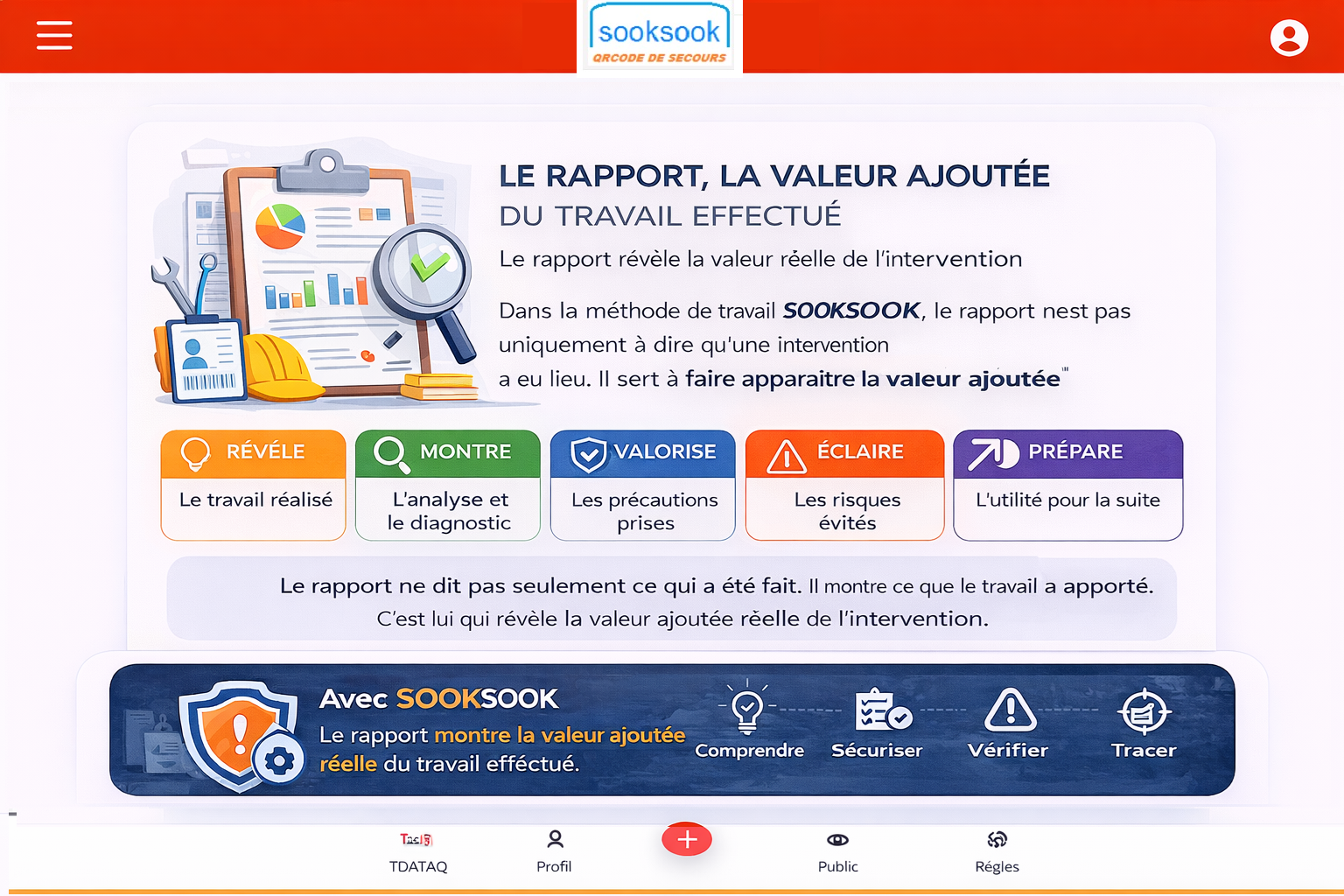 THE REPORT, THE ADDED VALUE OF THE WORK PERFORMED
The report reveals the real value of the intervention
In the SOOKSOOK working method, the report is not only used to say that an intervention has taken place. It is used to reveal thereal added value of the work carried out. This is a fundamental point. Very often, in the field, the value produced is much greater than what we see at first glance. An agent can analyze, secure, observe, anticipate, avoid a worsening, confirm a hypothesis, rule out a false lead, protect the continuation or improve the understanding of a situation. If this is not reported correctly, this value remains invisible.
The report therefore makes it possible to transform an action executed intorecognized, understandable and exploitable work. It gives relief to the intervention. It shows that the work did not only consist of “passing” or “doing something”, but of making a useful, structured and often decisive contribution for the future.
Real work is often richer than what meets the eye
In many technical, industrial or maintenance professions, a large part of the value is found in what is not immediately visible. Sometimes we only see the final result, or sometimes not even an immediate visible result. However, between the start and the end of an intervention, there may have been:
- a context analysis
- taking into account the risks
- prior security
- controls
- cross-checks
- tests
- a diagnosis
- a prudent decision
- a useful alert
- a clear direction for the future
Without a quality report, all this wealth is reduced to a few too simple words. The work exists, but it does not appear to its full extent. The report is therefore essential to highlight what the intervention really brought.
Added value is not limited to repair
An important point in the SOOKSOOK method is to understand that the value of work is not just a completed repair or a visible action. Sometimes the greatest added value is not in having repaired immediately, but in having:
- precisely identified the problem
- avoided a mistake
- prevented a worsening
- secure a situation
- clarified the need
- provided a reliable diagnosis
- allowed a better decision
- prepared correctly for the rest
The report helps show this reality. He avoids an overly reductive reading of the work. He reminds us that a good professional not only brings mechanical action, but also analysis, vigilance, discernment and method.
The report gives visibility to field intelligence
The terrain produces valuable intelligence. This intelligence manifests itself in the way of observing, understanding, comparing, interpreting, anticipating and choosing. However, if it is not formalized, it remains locked in the moment or in the head of the speaker.
The report allows us to give form to this intelligence. It shows why a hypothesis was retained or rejected, what was observed, what helped guide the diagnosis, what was considered important and what should be monitored. In this, the report reveals the quality of the reasoning undertaken on the ground.
This is particularly important, because an organization that does not know how to demonstrate the intelligence of its interventions often ends up underestimating the real value of its teams.
The report also values what was avoided
In real work, part of the added value is not seen in what has been done, but in what has beenavoided. Intervention can prevent:
- a more serious breakdown
- a prolonged shutdown
- a bad move
- a danger
- further degradation
- greater waste of time
- a misdirected decision
- a useless recovery
However, this type of value is often invisible if the report does not show it. This is why it is important that the intervention feedback is not limited to a short sentence or an overly general statement. It must make it possible to understand the real usefulness of the work undertaken.
The report thus gives visibility to prevention, anticipation and control, which are very strong forms of value in professional environments.
The report gives weight to the diagnosis
Once a diagnosis has been made, the report is essential. Without it, the diagnosis remains fragile, because it is not clearly shared or solidly transmitted. The report helps explain the process: what was observed, what was verified, what was tested, what was concluded, what remains to be confirmed if necessary.
This formalization gives weight to the work carried out. It shows that the intervention was not approximate, but was based on observations, verifications and clear logic. It also allows others to better understand the real level of progress of the situation.
In this sense, the report not only documents the work: it demonstrates its quality.
The report creates value for the future
A good report is not just about recounting the past. It also creates value for the future. It prepares possible outcomes, helps with decision-making, facilitates monitoring and makes the history more useful.
A quality report can provide:
- a saving of time
- a better understanding
- a more solid decision-making basis
- a reduction in unnecessary repetitions
- a clear direction for the next intervention
- better coordination between actors
- better anticipation of risks
In other words, the report extends the value of the intervention beyond the moment it was carried out. It allows the work done to continue to produce useful effects.
The report gives visible value to professionalism
Professionalism is not only measured in technical gestures. It is also seen in the ability to correctly report what has been done. A well-written report shows that the speaker masters his subject, understands his action and respects those who will then have to use the information.
This quality of restitution gives value to the work. It shows that the intervention was carried out seriously, methodically and aware of its collective usefulness. It also strengthens the credibility of the author of the report and, more broadly, the credibility of the organization.
The report then becomes a strong marker of professional rigor.
Why this added value must be visible
In many organizations, a lot of field work is undervalued because it is poorly reported. We see that an action has been taken, but we don’t always see:
- what she allowed
- what she avoided
- what she clarified
- what she secured
- what she prepared
- what she brought next
Making this value visible is essential for several reasons. This makes it possible to better recognize teams, to better exploit the information produced, to better manage the activity and to better defend the usefulness of the work carried out. In the SOOKSOOK method, this visibility is not incidental. It is part of the quality of the system.
What to include in the report
For the added value of the work to be visible, the report must go beyond a too-brief mention. It must accurately highlight what the intervention really achieved.
It is therefore useful to show, depending on the case:
- the real context;
- important findings
- the actions carried out
- the checks carried out
- the discarded points;
- risks identified or avoided
- the elements clarified
- the proposed suites
- the concrete contribution to understanding or controlling the situation.
The objective is not to make a text unnecessarily long, but to make a text fair enough so that the value of the work is not lost.
What to remember about the SOOKSOOK method
In the SOOKSOOK working method, the report serves to reveal the real added value of the work carried out. It shows what was understood, secured, verified, avoided, clarified or prepared for. It transforms field action into a visible, useful and lasting contribution.
The right reflex is therefore to consider the report not as a simple administrative closure, but as the support which allows the real scope of the intervention to be revealed.
In practice, the report makes it possible to value:
- the work actually done
- analysis and diagnosis
- the precautions taken
- the risks avoided
- the quality of the intervention
- usefulness for the future
- the competence of the speakers
- the technical memory of the organization
The report is not just about saying what was done. It serves to show what the work has brought.
It is he who reveals the real added value of the intervention, diagnosis or work carried out.