
sooksook-E-learning
Affiliate module 19 Sections170 LessonsDurée de vie
Event date
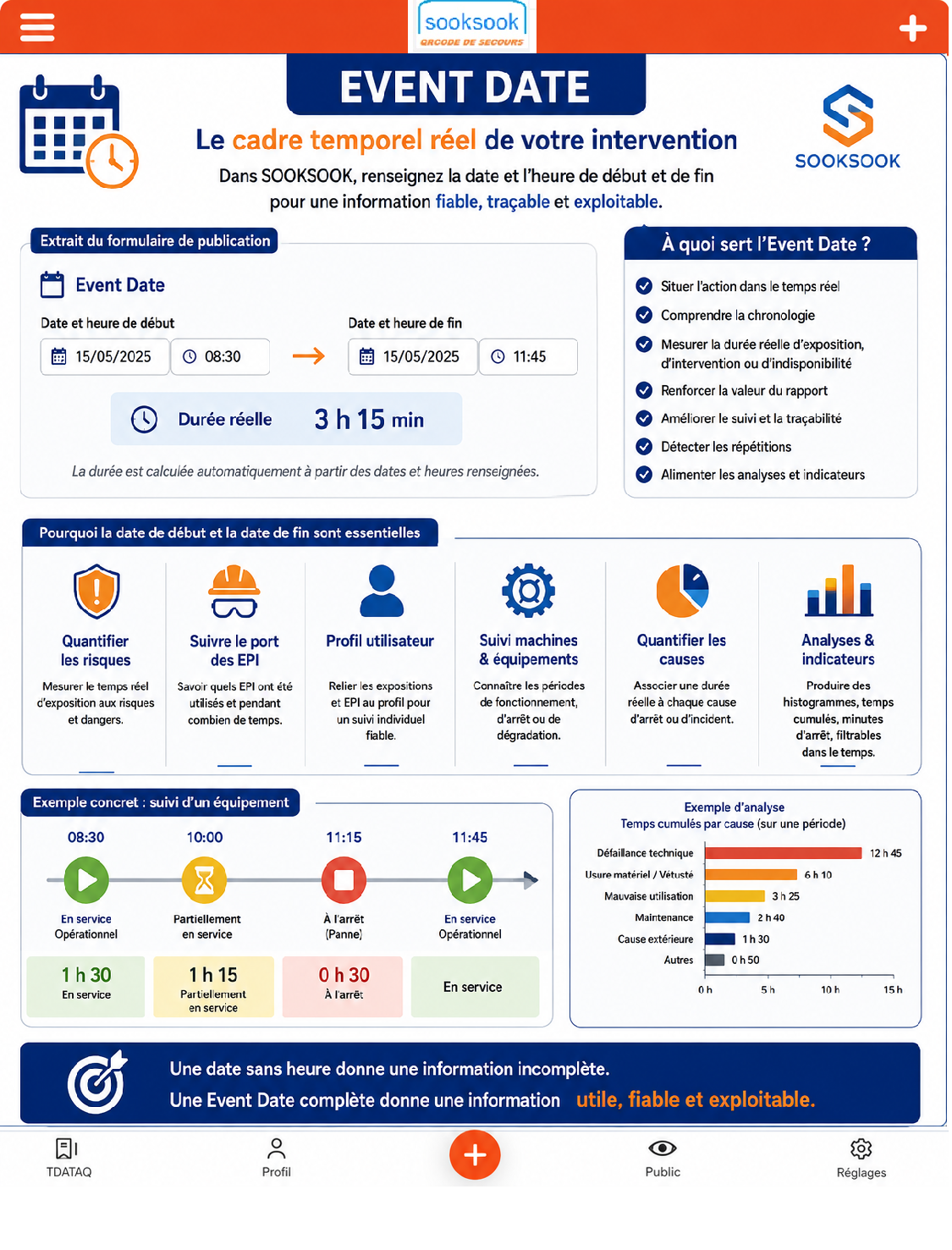
EVENT DATE: User
The temporal framework of the intervention in the publication forms
In the SOOKSOOK publication forms, the fieldEvent Dateis not only used to enter a date administratively. It constitutes thereal time frame of the intervention, that is to say the period during which the action began, took place and ended.
Concretely, this framework makes it possible to include:
- la start date and time ;
- la end date and time ;
- and therefore theactual duration of exposure, intervention or presence in a given situation.
This information is essential, because an intervention does not have the same meaning depending on whether it lasts 10 minutes, 2 hours, half a day or several days. The document you added also reminds us that, in the SOOKSOOK method, the date is never a secondary detail: it allows us to situate the action in time, understand the chronology, reinforce the value of the report, improve monitoring, detect repetitions and consolidate traceability.
Why the start date and end date are essential
From a field perspective, the date alone is not always enough.
What often matters is theactual working range.
The act of providing astart timeand oneend timeallows you to know:
- when the intervention actually started
- when it actually ended
- how long the user remained exposed to a situation
- how long a risk has been present
- how long certain PPE had to be worn
- how long an area or machine remained affected by an operation
In other words, the Event Date is not only used for dating.
It serves tomeasure in real time.
The importance of dates in the SOOKSOOK method
The document you provided explains it very clearly: information without a date loses much of its force. Without a clear time frame, it becomes more difficult to understand a situation, to reconstruct the sequence of events, to give meaning to a report or to ensure serious follow-up.
In SOOKSOOK, the date allows you to:
- situate the action in time
- place the facts in their real context
- understand what happened before and after
- link a report to a specific event
- follow the evolution of a situation
- compare actions with each other
- spot recurrences
- strengthen the credibility of published content
When we add to this thestart and end times, we move from simple dated information tousable temporal information.
Quantify exposure time to risks and dangers
One of the great interests of the frameworkEvent Dateis to allow aquantification of exposure time.
When a user fills out a form by entering:
- les risks/dangersmet
- les EPI requis
- la start date and time
- la end date and time
the platform can link this data together.
This then allows us to know, in a much more reliable way:
- how long a user has been exposed to a given risk
- how long he worked in a specific danger zone
- how long did an activity wearing reinforced PPE last?
- how long certain constraints were actually supported
Example :
- 2h15 intervention in ATEX zone
- 1 hour 40 minutes of work wearing a fall arrest harness
- 45 min activity under chemical risk
- 3 hour presence with mandatory hearing protection
- 1 hour 20 minute operation with respiratory mask and protective gloves
This approach gives much greater depth than a simple box checked “risk present” or “PPE used”.
Link exposure to user profile
There, logic becomes very powerful.
If the risks, dangers and PPE indicated in the form are linked to theuser profile, then it becomes possible to construct areliable individual monitoring over time.
We no longer just know that a user has carried out an intervention.
We can also know:
- on which risk families it intervenes the most
- how often he is exposed to certain dangers
- how much cumulative time he spent in particular contexts
- what PPE he had to wear most often
- on which activities he is most requested
- which exhibitions recur regularly in its journey
This logic makes it possible to move from a simple publication history to afiner reading of actual exposure at work.
A more reliable basis for prevention monitoring
Thanks to this quantification, the company can have a more solid vision of the reality on the ground.
For example, it can better track:
- cumulative times of exposure to noise
- exposure times to hazardous atmospheres
- the work at height actually carried out
- periods spent in coactivity
- the frequency of wearing certain PPE
- the professions or users most exposed to certain dangers
This helps to strengthen:
- prevention
- traceability
- the analysis
- the consistency of user profiles
- and the quality of HSE management
Where many systems are limited to signaling that a risk exists, SOOKSOOK can go further by documentingthe actual duration of exposure.
Better monitoring of PPE wearing
The same reasoning applies toEPI.
If a form indicates:
- what PPE was needed
- for what activity
- over what exact period
then it becomes possible to link to the user profile not only the fact that he wore PPE, but alsoin what context et for how long.
This can help you better track:
- the actual use of fall protection
- frequency of use of hearing protection
- the duration of wearing masks or respiratory protection
- the use of gloves, visors, harnesses, gas detectors, etc.
This does not replace regulatory obligations or medical monitoring when they exist, but it providesreliable operational base, directly from the field and publications.
Useful data for future analysis
The interest is also analytical.
Ultimately, the associated start and end dates:
- to the risks
- to the dangers
- to PPE
- to professional families
- to equipment
- to areas
make it possible to construct much more intelligent readings:
- which professions are most exposed to what
- over what periods
- with what durations
- with which PPE
- on which supports or areas
- and how often
We can thus move from a simple declarative system to amore robust tracking data.
Better reliability of the user profile
The user profile then becomes much richer.
It not only shows:
- the publications produced
- badges obtained
- completed e-learnings
it can also reflect, in more advanced logic:
- intervention contexts
- families of risks encountered
- cumulative exposure times
- the most commonly needed PPE
- the areas of activity actually practiced
This gives a more realistic reading of the user's field activity.
Logic consistent with the SOOKSOOK method
This use of the Event Date is perfectly consistent with the SOOKSOOK method.
The document you provided already emphasizes that the date:
- gives a real anchor to the information
- helps to understand the sequence of events
- enhances the value of the report
- is essential for monitoring
- helps detect repetitions
- consolidates traceability
- protects against blur and approximation
- has a strong safety value
With the framedate start time end time, this logic becomes even stronger, because the date no longer serves only to situate an action: it also serves tomeasure its temporal intensity.
In the SOOKSOOK publication forms, the fieldEvent Datecorresponds to the actual time frame of the intervention. It allows you to inform thestart date and timeas well as theend date and time, in order to precisely situate the action in time. This information is essential in the SOOKSOOK method, because an undated action loses a large part of its value: it becomes more difficult to understand, to follow, to place in the chronology and to exploit in the history. By associating this temporal framework withrisks/dangersdeclared andEPIentered in the form, SOOKSOOK also allows you toquantify actual exposure timein certain work situations. This logic can then enrich theuser profile, by offering more reliable monitoring of exposures, intervention contexts and the wearing of PPE over time. The Event Date is therefore not only used to date an action: it is used to make the intervention more understandable, more traceable and more usable, including from the angle of prevention and monitoring of exposures.
With SOOKSOOK, the start date and the end date are not only used to situate an intervention: they also make it possible to measure more precisely the real time of exposure to risks, dangers and the wearing of PPE, in order to improve the reliability of user monitoring.
EVENT DATE: machine machine equipment device
An essential field for reports, machine monitoring and traceability over time
In SOOKSOOK, the fieldEvent Dateis not only used to date a publication. It is used to define thereal time frameof the intervention or event, with:
- la start date and time
- la end date and time
- and therefore theactual durationaction, stoppage, unavailability or exposure
The text of your module clearly reminds us: in the SOOKSOOK method, the date is essential to situate the action, understand the chronology, reinforce the value of the report, improve monitoring, detect repetitions, consolidate traceability and avoid vagueness. An action without a date loses part of its meaning; with a clear date, it becomes understandable, monitored and usable over time.
An essential role in report publications
Sidereport publication, the Event Date is particularly important for:
- reports
- diagnostics
- maintenances
- repairs
- troubleshooting
- travaux
- checks
For what
Because a technical report doesn’t just need to saywhat was done. It must also say:
- quandthis was done
- how longit lasted
- in what statethe equipment was located
- whenthe situation has evolved
- et for how longthe machine, equipment, device or installation was affected
The report then becomes much more reliable, because it no longer just describes an event: it describes an eventlocated in real time. This directly reinforces its value for maintenance, operation, production, management and technical monitoring.
An essential basis for monitoring machines, gear, equipment and devices
The Event Date also plays a central role in thetraceability of technical supports :
- machine
- engin
- equipment
- appareil
- installation
Thanks to the start date and the end date, SOOKSOOK can place each publication in the real history of the medium. This allows you to know:
- when did a problem start
- when a machine has stopped
- how long she was unavailable
- when it was returned to service
- when it was only partially operational
- how long did each state last
This gives real depth to the story.
We no longer just read a series of publications. We read aactionable technical timeline.
Quantify the causes over time
This logic also allowsquantify the causeslinked to shutdowns, unavailability or disruptions.
In your reports, the Event Date allows you to attach a real duration to causes such as:
- Technical failure
- Not determined
- On duty upon arrival
- Material wear / obsolescence
- Misuse
- Vandalism / Malice
- External cause
- Power cut
- Sinistres
- Others without stopping
- Maintenance
This means that we can measure, for each cause:
- le cumulative time
- le number of publicationsconcerned
- les associated minutes or hours
- la frequency of occurrence
- and thedistribution over time
This quantification is very important, because it allows us to move away from a vague reading such as “there were several problems”, and towards a more precise reading:
- how much time was wasted
- which cause comes up the most
- which cause weighs the most?
- what cause repeats itself
- and how the situation evolves over a given period
Track actual condition/status of equipment
The Event Date also allows you to precisely follow thestateor thestatutof equipment, device, machine or installation.
For example, it becomes possible to distinguish and quantify the durations spent in the following states:
- ⌛️Partially in service
- 🚫 Off
- 🟢 In service / Operational
This point is essential, because a machine is not simply “broken” or “running”. It can also go through intermediate states, temporary degradations or situations where it partially functions.
Thanks to the time frame of the form, these statuses can be linked to real durations, which allows:
- improve availability reading
- calculate downtime
- to view times partially in service
- to distinguish the truly operational periods
- to consolidate performance monitoring
Populate the “Machine exposure” tab
The Event Date also allows you to feed what you call themachine exposure tab.
In this logic, each dated publication is not only used to keep track. It also serves to provide a consolidated reading of the behavior of the support over time.
This provides a more robust view of:
- exposure to the causes of stopping
- exposure to technical defects
- the frequency of incidents
- periods of degraded operation
- cumulative times by state
- the actual duration of technical events
In other words, the Event Date transforms the publication intoanalysis data.
Produce histograms, dwell minutes and time-filterable readings
This is where the Event Date field takes on its full analytical value.
Because each publication has a beginning and an end, it becomes possible to generate:
- des histogrammes
- des cumulative time per cause
- des minutes of downtime
- des downtime
- des time partially on duty
- des operational times
- readings byperiod
- analyzesfilterable over time
This allows for example to filter:
- over a day
- a week
- one month
- a period of production
- a specific date range
- or a free history
Thanks to this temporal reading, the user or manager can better understand:
- what happened over a given period
- what causes dominated
- how much time was wasted
- how many publications concerned a shutdown
- and how the availability of equipment evolves over time
Link with prevention and monitoring of exposures
This same temporal logic also applies torisks, dangers and PPE.
When the user provides:
- the risks/dangers encountered
- the necessary PPE
- start date and time
- end date and time
SOOKSOOK can quantify thereal exposure timeto these situations and attach this information to the user profile.
We then obtain more reliable monitoring:
- time of exposure to risks
- time spent wearing PPE
- contexts actually encountered
- repetitive work situations
- and the user’s actual level of field engagement
The Event Date therefore serves both
- au technical report
- au machine tracking
- au management of causes
- to thereading the statuses
- to thehistogram production
- and atprevention/exposure monitoring
In SOOKSOOK, the fieldEvent Dateplays a central role in publication forms. It allows you to inform thestart date and timeas well as theend date and timean intervention, an event or a change of state. This information is essential, because it is not only used to date an action: it allows each publication to be precisely placed in the real time of the work, to reinforce the reliability of the reports, to improve monitoring and to consolidate traceability. In reporting publications related tomachines, gear, equipment, devices or installations, the Event Date also allows you toquantify the causesunavailability or technical event, such asTechnical failure, Not determined, In service on arrival, Equipment wear / Obsolescence, Misuse, Vandalism / Malicious, External cause, Power outage, Disasters, Others without shutdown or Maintenance. It also allows you to follow thestates / statusessupport, such asPartially in service, Off or In service / Operational, to feed themachine exposure tab, to calculate theminutes of downtime, to producehistogrammesand obtain analyzesfilterable over time. Finally, linked to risks, dangers and PPE, it also makes it possible to better quantify theexposure timeusers and enhance the reliability of their individual monitoring.
In SOOKSOOK, the Event Date is not only used to date a publication: it is used to measure, follow, compare and analyze over time both interventions and stoppages, causes, machine statuses and exposure to risks.